
Olympus Duodenoscope Infection Lawsuit | ERCP Superbug Claims
Were You Hospitalized With a Serious Infection After an ERCP?
Hospitalized After an ERCP? The Scope Used In Your Procedure May Have Been Contaminated.
Bouk Law is investigating claims that bacteria remain on certain Olympus duodenoscopes after reprocessing and transmit to later patients who undergo ERCP with the same scope, leading to serious infections. These claims are directed at Olympus America, Inc., its subsidiaries, and affiliated entities involved in the design, manufacture, distribution, and sale of these devices.
Patients undergo ERCP for medical treatment, not to contract a dangerous infection.
Contact us today to speak with an Olympus Duodenoscope attorney. Bouk Law can help determine whether an Olympus duodenoscope may have played a role.
Olympus Duodenoscope Infection Lawsuits
What Is an Olympus Duodenoscope Infection Lawsuit?
An Olympus duodenoscope infection lawsuit is a product-liability claim brought by a patient who developed a serious infection after undergoing an ERCP with a contaminated duodenoscope.
These lawsuits allege that the scopes’ design makes them difficult to clean effectively and that patients and health care providers were not adequately warned about the resulting infection risks.
If you developed a serious infection after an ERCP, you may not know which duodenoscope was used. Bouk Law can investigate that for you.
What is a Duodenoscope and ERCP Procedure?
To understand a duodenoscope infection lawsuit, it helps to first understand how the device is used. Endoscopic retrograde cholangiopancreatography (ERCP) is a procedure doctors use to diagnose and treat conditions affecting the bile ducts, gallbladder, liver, and pancreas.
ERCP is performed with a duodenoscope, a flexible, lighted medical device also known as a scope or endoscope. During the procedure, the physician guides the duodenoscope through the mouth, throat, and stomach into the small intestine to reach the biliary and pancreatic ducts.
How Can an Olympus Duodenoscope Transmit an Infection?
More than 600,000 ERCP procedures are performed in the United States each year, and Olympus states that approximately 500,000 of them involve an Olympus duodenoscope. The FDA reports similar annual procedure volumes.
Could the device used to treat you have exposed you to a dangerous infection?
A duodenoscope is not a simple instrument. Its intricate design includes narrow channels, moving components, and a recessed area containing the elevator mechanism, elevator cable, and channel. The elevator mechanism helps physicians guide medical instruments during treatment, but these hard-to-reach components can make the device difficult to thoroughly clean, disinfect, and inspect between patients.
These design features are a major focus of duodenoscope infection investigations because small recesses, seams, and moving parts around the elevator mechanism can retain contamination even after reprocessing.
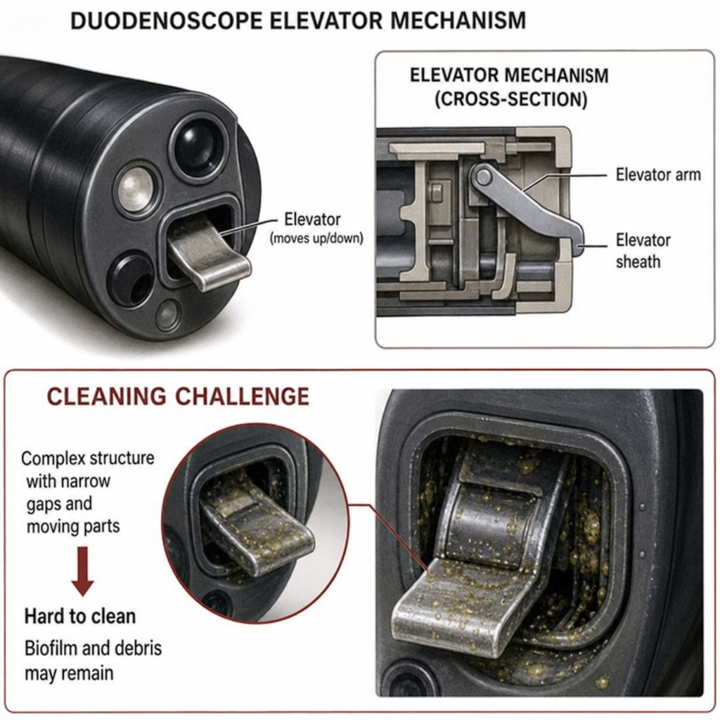
Bacteria can adhere to surfaces within difficult-to-clean portions of a duodenoscope and form a protective biofilm. Once established, biofilm can help shield microorganisms from liquid or gas disinfection, allowing persistent bacterial contamination to remain within the device.
This highlights the concern at the center of these cases: a duodenoscope may be reprocessed and used on the next patient while bacteria remain in areas that are exceptionally difficult to clean.
In 2013, the CDC alerted the FDA to a potential association between multidrug-resistant bacterial infections and duodenoscopes. Subsequent investigations found infections continued to occur even when users followed manufacturer cleaning, disinfection, and sterilization instructions. This finding is a central issue in Olympus duodenoscope infection lawsuits.
What Infections and Serious Conditions Have Been Linked to Duodenoscopes?
- Sepsis
- CRE (Carbapenem-resistant Enterobacteriaceae)
- Klebsiella pneumoniae, including drug-resistant strains
- VRE (Vancomycin-resistant Enterococcus)
- Pseudomonas aeruginosa
- E. coli
- Other serious gastrointestinal and drug-resistant bacteria
For the patient, the name of the bacteria may have been only the beginning.
A duodenoscope-related infection can lead to hospitalization, IV antibiotics, additional medical procedures, or treatment for serious complications such as sepsis.
Were you hospitalized with one of these infections after an ERCP?
The timing of the infection, culture results, ERCP records, hospitalization records, and identification of the scope used during the procedure may become important evidence in determining whether you have a potential claim.
What Symptoms Can Follow a Duodenoscope-Related Infection?
Signs of infection may appear after an ERCP. Symptoms associated with a suspected duodenoscope-related infection may include:
- Fever or chills
- Abdominal pain or tenderness
- Nausea or vomiting
- Jaundice
- Significant weakness or fatigue
- Bloodstream infection
- Recurrent infection
- Sepsis or septic shock
For a potential lawsuit, the diagnosis and medical evidence matter more than the symptom list alone.
Culture results, hospitalization records, procedure records, antibiotic treatment, and other medical records may help determine whether the infection can be connected to a duodenoscope
Many Reports of Infection: Timeline of FDA Action
FDA warning letters, recalls, and safety communications are central to Olympus duodenoscope infection lawsuits because they show what the company knew and when they knew it. Olympus was legally required to file Medical Device Reports (MDRs) to inform the FDA about these international outbreaks so U.S. hospitals could be warned. The timeline of regulatory actions reveals a pattern of delayed reporting and inadequate safety measures.
2015 | Federal Scrutiny Intensifies
The FDA issued a warning letter to Olympus Corporation of the Americas and required Olympus, Fujifilm, and Pentax to conduct postmarket surveillance studies. The FDA later reported higher-than-expected contamination rates in interim study results.
2018 | Additional FDA Action
The FDA issued another warning letter concerning Olympus’s compliance with required postmarket surveillance studies.
2023 | Olympus Duodenoscope Recall
The FDA posted a Class II recall involving the Olympus TJF-Q190V duodenoscope following reports involving patient infections and positive cultures. More than 6,400 devices were in commercial distribution.
2026 | Continued Regulatory Scrutiny
The FDA issued an import alert involving certain Olympus medical devices manufactured in Japan related to quality-system concerns.
Lawsuit Evidence: What Did Olympus Know About the Infection Risk?
DOJ investigation reveals Olympus concealed outbreaks and ignored expert warnings. Olympus was legally required to file Medical Device Reports (MDRs) to inform the FDA about these international outbreaks so U.S. hospitals could be warned. Despite an internal expert report warning Olympus that the unique, complex design of the TJF-Q180V scope trapped tissue and bacteria (making it nearly impossible to fully disinfect), the company failed to notify U.S. regulators while continuing to sell the devices.
Olympus duodenoscope infection lawsuits focus on what Olympus knew about the infection risks, when it knew, and whether hospitals, physicians, and patients were adequately warned.
2016 Senate Investigation: Links Duodenoscopes to Infection Outbreaks
A 2016 U.S. Senate investigation reported that closed-channel duodenoscopes were linked to at least 25 antibiotic-resistant infection outbreaks involving at least 250 patients worldwide between 2012 and spring 2015. The investigation concluded that Olympus knew as early as 2013 that certain duodenoscopes could harbor and spread bacteria despite proper cleaning procedures. Yet U.S. hospitals, physicians, and patients were not broadly warned about those risks until 2015.
Around the same time, patients who developed infections after ERCP procedures began filing lawsuits against Olympus—the same type of claim Bouk Law is investigating today. According to a 2016 Los Angeles Times report, court filings in one Pennsylvania patient lawsuit included internal Olympus communications discussing reports of infections associated with its duodenoscopes.
2018 DOJ Criminal Case: Guilty Plea and $80 Million Criminal Fine
Olympus Medical Systems Corporation admitted that it failed to submit required Medical Device Reports or supplemental reports regarding adverse events related to the TJF-Q180V duodenoscope between August 2012 and October 2014.
The admission came in November 2018, when the company pled guilty after the U.S. Department of Justice filed a three-count criminal Information. The charges involved introducing medical devices into interstate commerce that were misbranded under 21 U.S.C. § 352(t)(2), in violation of the Federal Food, Drug, and Cosmetic Act (FDCA), 21 U.S.C. §§ 331(a) and 333(a)(1).
The plea agreement describes unreported incidents in Europe in which multiple patients developed Pseudomonas and E. coli infections after procedures with the same scope. Under the agreement, the company is required to pay an $80 million criminal fine plus $5 million in criminal forfeiture.
As part of the plea agreement, Olympus is required to notify every U.S. customer that received a TJF-Q180V duodenoscope between August 2012 and October 2014 about the criminal charges and the plea.
Olympus’s record of delayed warnings and unreported infections has become key evidence in duodenoscope infection claims arising from ERCP procedures.
2018 FEDERAL CRIMINAL CASE
$80 Million Criminal Fine
Olympus pleaded guilty to failing to submit required adverse-event reports and was ordered to pay an $80 million criminal fine plus $5 million in criminal forfeiture.
Do I Qualify for an Olympus Duodenoscope Infection Lawsuit?
You may qualify for an Olympus scope claim if:
✅ An Olympus scope was used during your procedure.
✅ The procedure occurred in or after 2015.
✅ After the procedure you developed a serious infection or injury, including sepsis, a superbug infection, or tuberculosis (TB).
✅The infection required hospitalization and treatment with IV antibiotics.
✅ You may also qualify if you developed HIV after the procedure.
What if I don't Know Whether an Olympus Duodenoscope was used?
You don’t need to know before contacting Bouk Law.
With approximately 500,000 of the more than 600,000 ERCP procedures performed annually in the United States reportedly involving an Olympus duodenoscope, the manufacturer of the device used during your procedure is an important question to investigate.
Tell us what happened. We can investigate what scope was used
What Compensation May Be Available?
Depending on the circumstances of the claim, a person who suffered a serious infection may seek compensation for losses including:
- Medical expenses
- Lost income
- Pain and suffering
- Other losses associated with the injury
For families who lost a loved one, additional claims may also be available depending on applicable law. The value and availability of compensation depend on the facts of each case.
What Should You Do Next?
Deadlines can be short. If you developed a serious infection following an ERCP procedure, contact Bouk Law for a free case review. Preserve any medical records, hospitalization records, and culture results relating to your infection.
You may not know what model of duodenoscope was used during your ERCP, who manufactured it, or whether the device had been associated with prior infection concerns.
That is exactly what an investigation is designed to determine.
Bouk Law can review the circumstances of your procedure, investigate whether an Olympus duodenoscope was used, obtain relevant evidence, and evaluate whether you may qualify for an Olympus duodenoscope infection claim.
The first step is simply telling us what happened.
No Upfront Attorney Fees
Bouk Law handles these matters on a contingency-fee basis. You pay no attorney fee unless the firm recovers money for you.
No recovery. No attorney fee.
Why Choose Bouk Law?
- Nationwide Representation
- Direct attorney contact
- No recovery, no attorney fee
- Care and urgency
Frequently Asked Questions
What Olympus duodenoscope models have been involved in infection-related litigation?
Many Olympus duodenoscope infection lawsuits have focused on Olympus models such as the TJF-Q180V and TJF-Q190V. These devices have been the subject of FDA safety communications, recalls, government investigations, and private litigation involving allegations related to infection transmission, cleaning challenges, warnings, and adverse-event reporting.
Were Olympus duodenoscopes recalled?
Yes. The FDA posted a Class II recall involving the Olympus TJF-Q190V duodenoscope in 2023 following reports involving patient infections and positive cultures.
How long do I have to file a duodenoscope infection lawsuit?
Filing deadlines can vary by jurisdiction and the facts of the claim. A case-specific legal review is important when evaluating any applicable deadline.
Can family members bring a claim after a loved one dies from a duodenoscope infection?
Yes. In many states, surviving family members or a patient’s estate may be able to pursue a wrongful death or survival claim when a duodenoscope-related infection allegedly contributes to a patient’s death. Bouk Law can evaluate the circumstances of the procedure, infection, treatment, and death.
What is an ERCP procedure?
ERCP, or endoscopic retrograde cholangiopancreatography, is a procedure used to diagnose and treat conditions affecting the bile ducts, gallbladder, liver, and pancreas. Doctors commonly use ERCP to diagnose and treat gallstones, biliary strictures, cholangitis, gallstone pancreatitis, tumors, and other conditions. During the procedure, a duodenoscope is used to guide medical instruments.
What is the elevator mechanism on a duodenoscope?
The elevator mechanism helps physicians guide medical instruments through a duodenoscope during an ERCP. Moving a lever on the scope’s control section pulls or releases an internal wire, or elevator cable, connected to a small, hinged forceps elevator at the far distal tip of the duodenoscope. The mechanism’s recessed spaces, cable, channel, seams, and moving components are significant because they can be difficult to clean, disinfect, and inspect between patients.